


Choose a course that you enjoy
At KEV, you don’t just attend lectures – you’ll get involved in real-world projects whilst you’re still studying, working alongside our researchers and industry experts.
- Final project within the Bachelor study – you choose your topic from a range of topics
- Master’s thesis – as part of the follow-on Master’s programme
- Independent project – you can take part at any time during your studies, even if it is not linked to your final thesis
You can also link your project work to your coursework:
- Bachelor’s degree programme: KEV/VPP1–KEV/VPP5
- Master’s degree programme: KEV/SP1VE, KEV/SP2VE, KEV/SP1VT, KEV/SP2VT, KEV/SP1ES, KEV/SP2ES
You can join our team at any time during your studies. Choose from the listed topics, or come up with your own idea and develop it with the support of the KEV team.
You can also build on successful projects during your PhD studies.
You can find the current range of projects in the list of projects for students.
Our students. Their projects.
Test bench for the electric mountainboard’s drive unit
Adam Kratochvíl
As part of the ‘Project Development 3’ module, I designed and built a test rig for the drive system of an electric mountainboard. I analyse the ride data by recording the operating parameters directly from the drive inverter.

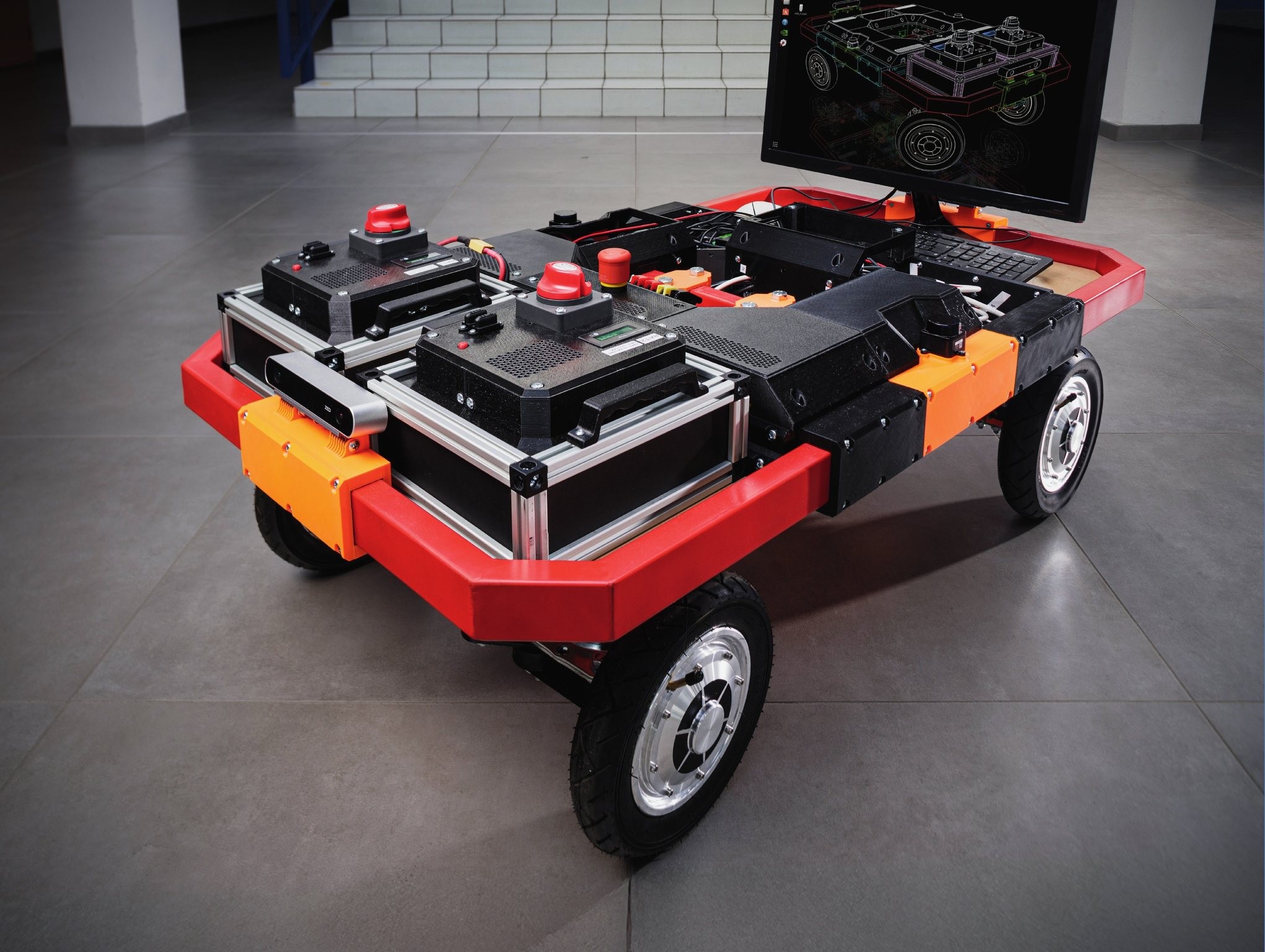
Mobile robotic platform
Tomáš Knopf
The platform I’m working on is based on the NVIDIA Jetson AGX Xavier computing module. It scans its surroundings using two LD19 lidars and ZED stereo cameras with a resolution of 2 × 2K. Power is supplied by two batteries with a total capacity of 2 kWh, enabling the platform to operate for long periods without recharging. It enables precise navigation and real-time image processing, making it ideally suited for the development of autonomous driving technologies.
Construction and programming of a training system for industrial drives
Jakub Racek, Vojtěch Danda, Matěj Černý
As part of a long-term project, we are building and programming a test rig featuring three types of electric motor: DC, asynchronous and synchronous. The test rig is used for teaching industrial drives, with a focus on electronics, control and regulation. The motors can place loads on one another, allowing us to demonstrate their characteristics, dynamics and behaviour under various operating conditions.

Electric minibike
Jan Hocke
As a team, we converted a minibike with an internal combustion engine into a fully electric one. I was responsible for assembling and connecting all the components. I am now continuing to work on the minibike as part of my final-year project, in which I am developing an inverter.
