


Choose a course that you enjoy
At KEV, you don’t just attend lectures – you’ll get involved in real-world projects whilst you’re still studying, working alongside our researchers and industry experts.
- Final project within the Bachelor study – you choose your topic from a range of topics
- Master’s thesis – as part of the follow-on Master’s programme
- Independent project – you can take part at any time during your studies, even if it is not linked to your final thesis
You can also link your project work to your coursework:
- Bachelor’s degree programme: KEV/VPP1–KEV/VPP5
- Master’s degree programme: KEV/SP1VE, KEV/SP2VE, KEV/SP1VT, KEV/SP2VT, KEV/SP1ES, KEV/SP2ES
You can join our team at any time during your studies. Choose from the listed topics, or come up with your own idea and develop it with the support of the KEV team.
You can also build on successful projects during your PhD studies.
You can find the current range of projects in the list of projects for students.
TRANSPORT TECHNOLOGY, ELECTRIC MOBILITY AND MOTORSPORT
We specialise in electric vehicles, ranging from the smallest – such as electric scooters and motorbikes – through to electric cars and go-karts, right up to large vehicles such as electric buses, trolleybuses, trams and locomotives, as well as boats and aeroplanes. We also work on key components of powertrains for motorsport (Formula Student, SuperKart, WRC, e-bikes).
Furthermore, we work on transport simulators, modelling, planning and traffic management.
Our research also includes the development of compact high-speed powertrains; in collaboration with industrial partners, we have succeeded in achieving significant reductions in the weight and volume of the powertrain whilst maintaining full traction performance. We also focus on multi-phase electric motors, which are smaller, more powerful and more reliable than traditional three-phase solutions – they are capable of continuing to operate even in the event of a failure in one or more phases.

Fig.: Electric go-kart. A student project from 2012
MECHATRONICS, ROBOTICS AND INDUSTRIAL TECHNOLOGIES / AUTOMATION
An important area of our activities is mechatronics, robotics and industrial automation, where we focus on individual components and the control of robots, specialised manipulators, machine tools, production equipment and production lines.
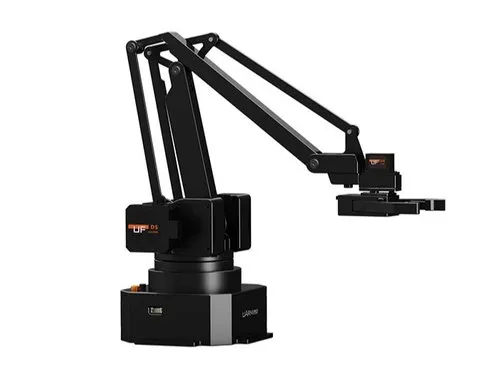
Fig.: Model of the uARM robotic arm designed for teaching robotics.
MODERN ENERGY, ENERGY CONVERSION
We specialise in power electronics technologies for the transmission and distribution of electricity, smart grids and the efficient use of renewable energy sources. We design new technologies for the generation of electricity and heat. In the field of power conversion, we also work on specialised technologies for electric heating and wireless power transmission, for example.

Fig.: Smart home demonstration
DESIGN, CONSTRUCTION AND TESTING OF ELECTRICAL MACHINES AND EQUIPMENT
An integral part of almost every complex piece of equipment or technology is electrical machines and other devices. At the department, we focus on their design, modelling, construction, and testing.

Fig.: Working with software for modelling electrical machines
Artificial Intelligence
The operation of electrical equipment requires an understanding of the fundamental principles governing its behaviour and the derivation of a mathematical description. Historically, these simplified models and control strategies were devised by people on the basis of experience and experimentation. Nowadays, such a vast amount of data and high-speed simulators are available that it is possible to use artificial intelligence and machine learning methods to find more accurate models and more precise control strategies. These methods can be used to improve the design of electrical equipment.
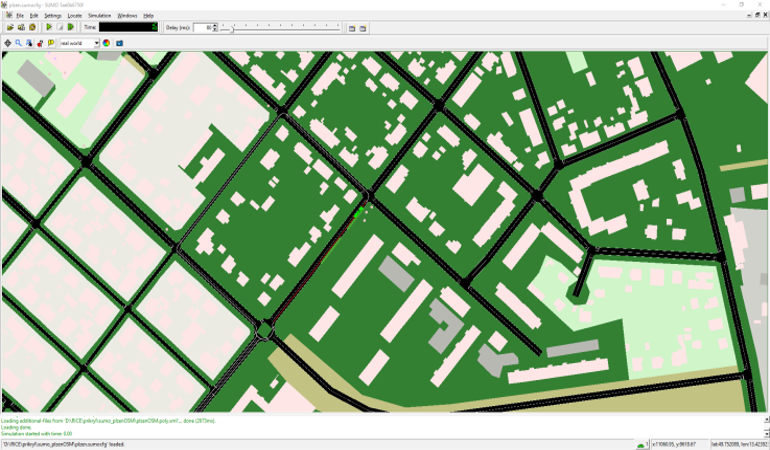
Fig.: Transport modelling software.
Student Formula
Formula Student is an international competition organised by SAE International, with a history dating back to 1979, in which more than 600 universities currently take part. In the past, the UWB Formula team http://uwbracing.cz/ achieved impressive results in numerous races in the internal combustion engine category. Students are now developing an electric-powered formula car powered by a traction battery. At our department, you will learn more about the design of electric motors, inverters, traction batteries (including BMS) and other associated electronics.
- A project you can join straight away.
- Areas of potential collaboration:
- design and manufacture of electronics
- programming of units, communication and visualisation
- preparation of documentation and participation in races.
- It doesn’t matter what skills you have now, but rather which ones you want to acquire during your studies.
